ACUMATICA
Financial Management
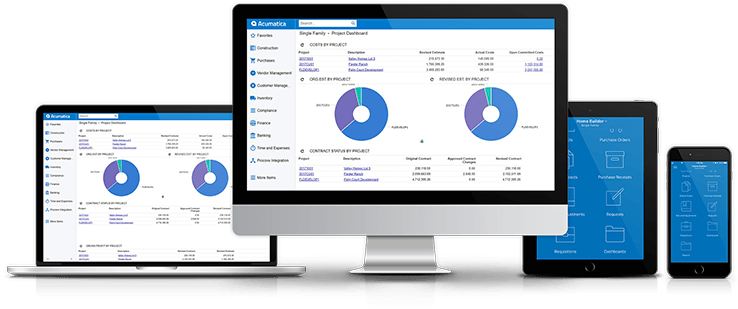
Financial Management cover the full suite of accounting functions designed to provide solutions for complex requirements yet easy to implement and operate.
The financial management suite fully integrates with CRM, Distribution, Manufacturing, Field Services and Project accounting.
REQUEST A DEMO +12 003 3470
Automation with workflow ensure quicker month end processes which saves time and costs. Management get access to business information quicker to make informed decisions.
Multiple companies’ information is managed in one single centralized database providing accurate real time information for management.
Acumatica manage international requirements effectively through multi-currency, multi company, multi locations.
Multiple business entities are automatically reported separately and consolidated for balance sheet and tax purposes.
The GL chart of accounts is extended in sub-accounts for further breakdown of transactions for reporting and analytical purposes by configuring and defining multiple segments for the sub-accounts. Departmental reporting is a different view of the transactions processed.
The sub-accounts and departments created above provide for nearly unlimited reporting dimensions and analysis.
Access to accounts and sub-accounts is managed with permissions allocated to certain roles to ensure that sensitive data is protected.
Data from multiple entities and multiple currencies are combined with adjustments for inter-company transfers and minority interests to avoid duplication.
Source documents can be attached during the transaction capturing process streamlining the invoice and payment approval process. Easy drill down to the attached document or email makes access simple.
Prepayment requests and issues are kept separately from the regular AP account. The prepayments can be applied to the invoices on receipt of the invoices.
Deferred expense schedules can be assigned by AP line item which will automatically split payments between prepaid account and expense accounts.
VAT Taxes are automatically calculated based on the tax rules defined for multiple tax items per document line. Withholding TAX is also supported.
Various business processes are catered for in the capturing, approval, payment, reconciliation and release of invoices and related payments. Time is saved utilising the various payment methods available in Acumatica which are extended with vendor discounts and aligning payments with cash flows.
Predictive and flexible entry screens allow for efficient data capture reducing errors by default account settings relating to sub-accounts, payment terms and discounts by vendor.
Gains and Losses are automatically calculated during the processing of foreign currency related transactions which include payments, receipts and bank account transfers.
Adjusting entries are automatically created during the processing of currency transactions which auto reverse when the open documents are settled.
The translation of foreign operating subsidiaries trail balance follows the FASB-52 standard. Automatic calculation of gains and losses during the consolidation of foreign currency trail balance are reflected in the consolidated financial statement.
Deferred revenue is automatically calculated, according to pre-established scheduled, and posted and recognised in financial statements
Expense amortisation is achieved using templates applied to accounts payable entries. During the processing of Sales Orders and Purchase Orders, inventory items can be attached to schedules to facilitate the accounting rules required to process amortisation.
Schedules can be created using templates provided or for complex requirements, schedules can be configured from scratch. These schedules are linked to specific transactions and line numbers on the income statement.
The configuration of complex multi-element sales scenarios, as required by ASC 606 and IFRS 15, is customised in Acumatica to meet the unique business requirements and workflow.
Revenue recognition across financial periods can be evenly spread or prorated by number of days or even during the payment receipting process. The methods available comply currently with all the recognition requirements.
Business performance is significantly improved by crating automated recurring billing, payment and collection transactions.
Contracts can be setup to apply billing and revenue transactions using monthly, quarter or yearly schedules or mixed time-periods – even on the same contract
Pricing and subscription plans which are aligned with business requirements will attract a broader customer base.
Predefined depreciation schedules include accelerated cost recovery system, straight line, declining balance, sum of years digits, remaining value, flat rate, units of production. Complex depreciation methods can be created to add to the above list. Depreciation methods are applied as useful life and recovery periods.
Purchase orders can easily be converted into fixed assets without re-entering data. The conversion process is simplified by categorised asset type purchases.
Multiple depreciation books can be simultaneously maintained using multiple calendars and special deprecation bonusses and tax benefit rules.
Control on the creation of customer invoices and statements are flexible with printing options to choose from ensuring the customer facing business forms remain professional and easy to extract.
Payment processing using credit cards are made easy with the PCI-compliant credit card facility.
Deferred revenue codes can be defined individual line items on the invoice to support various revenue recognition requirements.
Companies or franchises with multiple branches can be configured to manage parent child relationships to enhance the credit control, payment allocation, dunning rules and statement processing.
Cash transactions are automatically generated from General Ledger, Accounts Receivable and Accounts Payable.
Funds can easily be transferred between Cash Accounts or tracked as in-transit. Transfers in different currencies calculate automatically realised currency gain or losses.
The bank reconciliation process is simplified and bank charges and bank interest or omitted transactions can be created during the reconciliation process.
Various tax requirements are managed which include Sales Taxes, Withholding Taxes, VAT, Reverse Taxes and Use Taxes. Tax calculations can be performed on each line item or on the document amount using multi rates with different start and ending dates allowing for minimum and maximum tax amount.
All the financial modules which requires tax management are linked. Calculation of taxes is automatic based on the tax rules defined relating the customer, employee or vendor location and the tax category assigned tot eh inventory items. Tax is posted to allocated GL Accounts configured in the Tax Management setup.
Tax bill is automatically generated during the tax cycle creating the accounts payable entries and produce tax reporting in the format required for submission.
Intercompany accounting provides for cash, vendor payments and customer invoicing attribution to income and expense accounts in the initiation company clearing through intercompany loan account automatically.
Customised reporting can be extracted across one or selected multiple companies with integrated query and reporting tools. Intercompany transactions can be eliminated with reporting tools.
Access control of groups of users are controlled based on roles associated with specific transactions to specific companies. Users need not log in to switch between multiple companies, but only need to change the views.
Management of financial periods is performed separately for each company which include the activation and deactivation and open and close to allow posting to open or closed periods.
The navigation between companies and branches is very easy by selecting from drop down menu the available companies and branches that exist.
Connecting to Acumatica in real time delivers up to date information.
Acumatica’s mobile application offer a wide variety of functionality standard within the system. The Acumatica Framework provide tools and languages to developers to develop advanced mobile solutions within the framework extending the functionality specifically required for unique business needs.
The mobile app is real time connected which result in immediate update of changes made.
The level of security is improved using the mobile app fingerprint reader. Other functions like the camera add further capabilities.